A GLASS SCHOOL IN MURANO AS A UNIQUE EXPERIENCE IN THE WORLD The tradition of glassworking in Murano has very ancient origins: the presence of such activity is documented in the lagoon since VII Century. Later, in 1291, a decree of the Venice Republic orders the displacement of the glass factories from the historical centre of Venice to Murano island, in order to protect Venice from fires. The date marks the beginning of an incomparable success of the island that becomes the worldwide Capital of Glass, a place where families hand down, from generation to generation, recipes, techniques and secrets inimitable by any other glassworker in the world. Finally now, after more than six hundred years, very skilled glass masters, descendants of the same families keeping jealously the secrets, decide to spread their precious knowledge going out of the lagoon boundary and looking for a necessary comparison with the international reality. The historical roots of glass art have to be searched here, in Murano. And no place is better to discover its secrets.
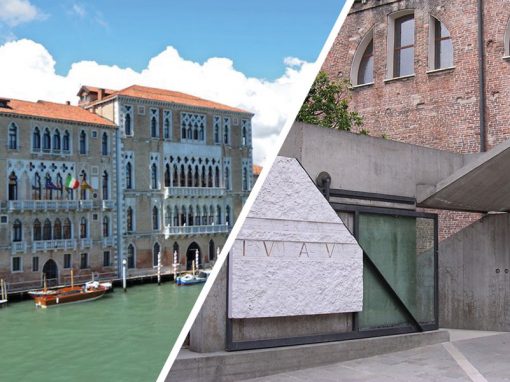
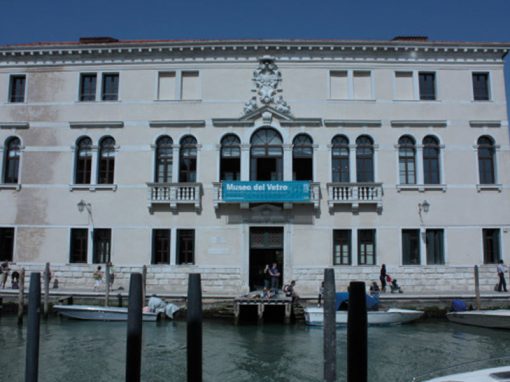
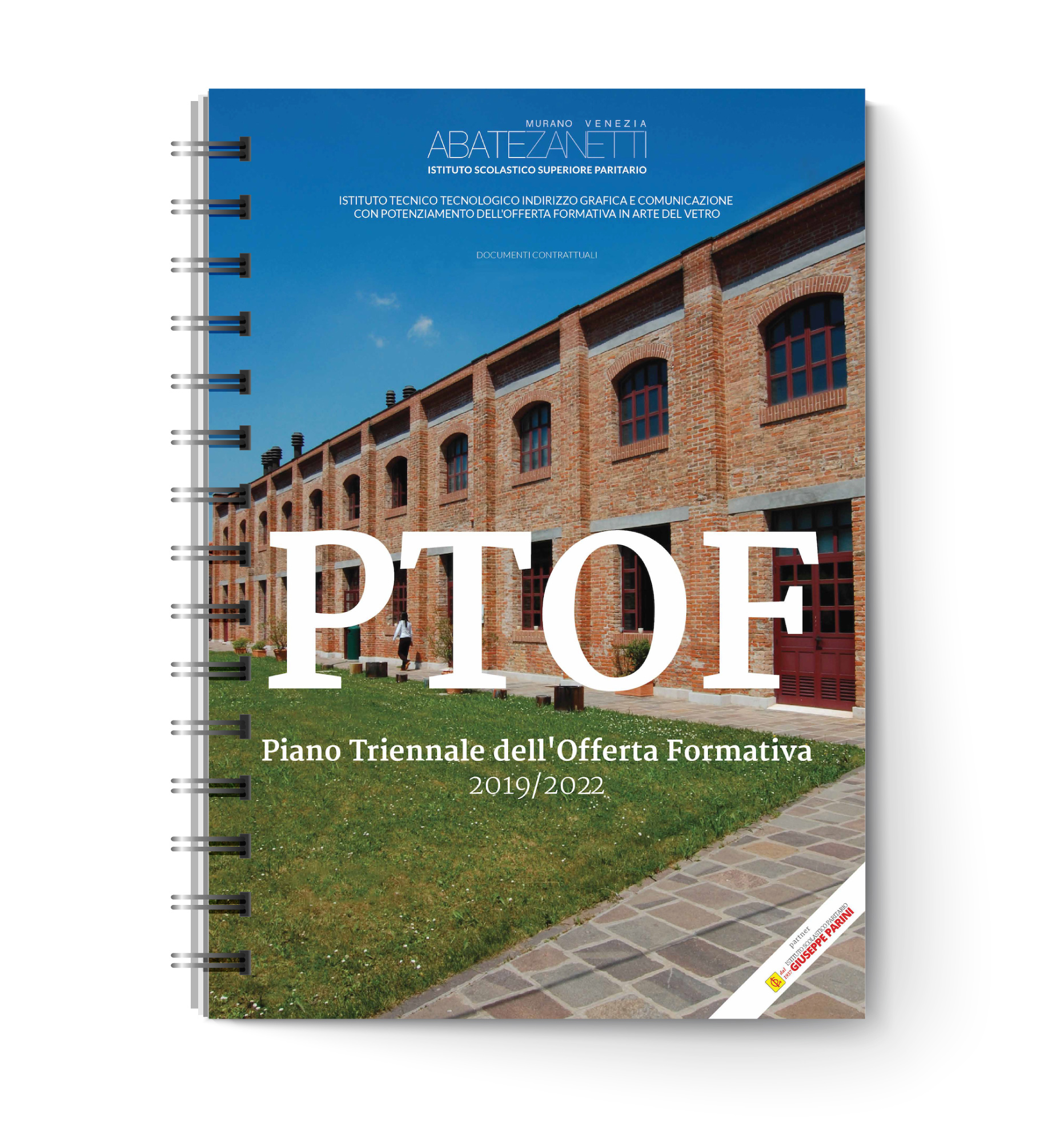
THE PLACE Is a magnificent building of the 30’s, an example of archeological industry, perfectly restored maintaining its original style. It is equipped with big rooms for facilities, a hall for lectures, garden, internet-point with wi-fi, cafeteria and library: all this at students disposal.
FACILITIES AND TECHNIQUES The hotshop of the School is equipped in order to develop all the typical Murano techniques like Glassblowing and Solid Working. Glassblowing, in particular, discovered in ancient age in the Middle East and introduced by the Romans, allows to create objects for daily use, furnishing and lighting.
GLASSBLOWING
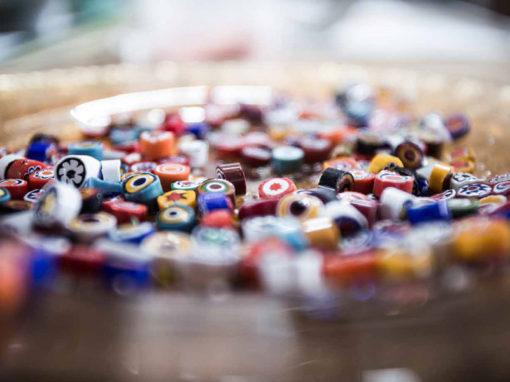
The glassblowing technique aims to realize objects like glasses, plates, vases and, in particular, the Venetian goblet. Different types of decorations are applied, developing complex techniques such as filigree “à la façon de Venise” (zanfirico), reticella filigree, pick-up canes and murrina, and incalmo. Solid working enables to realize sculptures, artistic objects and objects of design. In order to familiarize with this subject a series of basic operations are necessary as they have a specific terminology, well-established during centuries in Venice and handed down up to now from father to son.
FUSING Fusing, also called slumping, is a modern technique. It enables to create many different objects and works of art using different types of glass: the glass sheet can be modelled, at high temperatures , into various forms, for example, little pieces of murrine, frit, wires and sticks. The use of oxides and enamels will give birth to incredible “paintings” with unexpected chromatic and three-dimensional effects. Fusing enables to create stained glass, objects, gifts items, sculptures-plates and costume jewellery with a lot of paintings interventions. Starting from colourless glass and working on various superimposed layers on the same object, a complex of contrasting colours or a shading sequence of colours is obtainable.
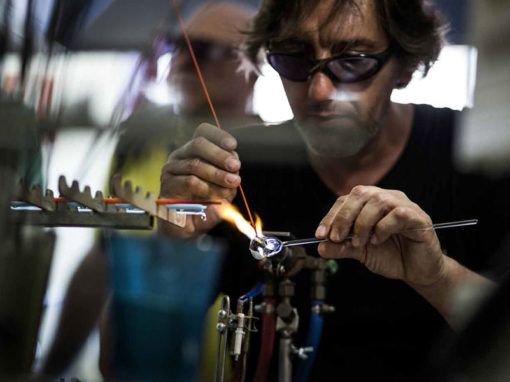
LAMPWORKING The studio is equipped with work benches with methane gas and air flames for the traditional Venetian bead making. The studio has exhaust fans to clean air efficiently, an annealing kiln and all the necessary tools available for small glass blowing and lamwork murrine. This is an ancient second-stage working technique, used in Venice since the Renaissance and developed then from the XVIII th century on. Semi-worked glass rods of different diameters and thickness are first softened by the heat of an horizontal flame fed by methane gas and oxygen (or air), then shaped with the help of small tools, making objects like small animals or human figures. Beads are made by softening a glass rod covered with detaching material. Through the lampworking technique, sculptures, figures, jewellery, drop earrings, rings can be created. The mixture of methane gas and air and the consequent lower temperature allow more delicate decorations, typical of Venetian bead. Both the typical Murano soda-calcium glass rod and the borosilicate glass rod, invented in Usa in 1922, called Pirex, can be used in the blown lampworked glass.
TEACHERS The School teachers are skilled and their personal resumes boast years of experience in the many Murano and international glass techniques. The majority of them come from Murano and are descendants of old and prestigious families of glass masters.
ONE WEEK COURSE: WEEK 1 Learning of one of the three techniques (free choice) ONE WEEK COURSE: WEEK 2 Learning of one of the three techniques (free choice) ONE WEEK COURSE: WEEK 3 Learning of one of the three techniques (free choice) (possibility to repeat the course)
ONE WEEK COURSES 1-2-3 - DATES Week 1: from 15 Feb – to 19 Feb Week 2: from 22 Feb – to 26 Feb Week 3: from 1 Mar – to 5 Mar
Week 1: from 8 Mar to 12 Mar Week 2: from 15 Mar to 19 Mar Week 3: from 22 Mar to 26 Mar
Week 1: from 6 Apr to 9 Apr Week 2: from 12 Apr to 16 Apr Week 3: from 19 Apr to 23 Apr
Week 1: from 26 Apr to 30 Apr Week 2: from 3 May to 7 May Week 3: from 10 May to 14 May
Week 1: from 17 May to 21 May Week 2: from 24 May to 28 May Week 3: from 31 May to 4 Jun
(5TH of April and 2nd June are Holydays. In those weeks there’ll be 4 days of class with 5 hrs in the morning and 4 hrs in the afternoon)
Theoretical part (common to all workshops): hours 4 Practical part for each workshop: hours 16 Total amount for each workshop: hours 20 Level: beginner (morning) Previous knowledge: none (morning), basic knowledge (afternoon) For each one of the three techniques it will be possible to follow a deepening in the afternoon during the following weeks of the attended workshop. The course will be dealing with 15 hours practise , assisted and guided by a teacher, from 2.00 pm until 5.00 pm, from Monday to Friday. For each one of the three techniques, minimum and maximum numbers of presence in the morning are valid, but it will be necessary, in order to attend the afternoon deepenings, to have carried out at least the 16 morning hours ( otherwise to prove to be not a beginner).
PRICES (Vat included) Morning: Furnace euro 720 Morning: Lampworking or Fusing euro 600 Afternoon:Furnace euro 576 Afternoon Lampworking or Fusing euro 480 (it is possible to make combinations of 2 or more weeks, morning, afternoon or both, with the courses you prefer. Anyone enrolling for 2 or more weeks will receive a discount of 10%). The cost of the course include: theoretical hours, practice hours, 1entrance to Glass Museum, didactic material.
MINIMUM/MAXIMUM NUMBER OF STUDENT PER CLASS Fusing: 5/10 people Furnace: 4/8 people Lampworking: 5/10 people NB: Lessons will be held both in Italian and English.
ENROLMENT: 15 days before the beginning of each course if lodging is not requested 30 days if lodging is requested Deposit:euro 250 It is possible to pay with credit card. Contact the School. Bank transfer:
SERVICES facilities for boat transportation weekly/monthly pass cafeteria inside the School pantry internet-point with wi-fi library secretary office
COURSES AIM
These workshops offer the possibility to deepen, according to preference, one of the most famous and successful techniques that are furnace, fusing and lampworking. The theoretical part will be common for all students, regardless of the type of technique they want to learn. PRACTICAL PART. Students may choose, each week, one among the three techniques listed below:
LAMPWORKING.
Students, after having received information about equipment and safety, will be introduced to the lampworking technique. Objective of the course is the realization of the first basic objects, made first hand-built then with the use of tweezers using glass rods of different colours and dimensions. During the workshop also the technique of Venetian bead will be studied, starting from the spherical shape, and then reaching different shapes and decorations on the surface.
FURNACE.
The aim is to gain familiarity with the basic technique of warm glass and, through the practice of such an ancient tradition, to leap in time thanks to continuous oral spread of the most ancient method of glass production. Students will learn how to gather glass from the kiln (first pick up), to fix up the nucleus of the glass object (marvering and blowing), then to pick up later and give a first shape to the glass mass, to prepare a punty for the junction, give glass to the master, up to realization, first helped by others and then by oneself, of simple objects such as a glass or a bowl.
FUSING.
The workshop for beginners introduces the fundamental technique of flat fusing. Cutting, assembly and firing of simple flat objects, will allow students to know possibilities and limits of this technique. Once a good level of knowledge of basic techniques is reached , student will be dealing with flat fusion of various layers, using frits , wires, sheets of different thickness. Slumping techniques will be also covered.
THEORETICAL PART (in common) Hours of lessons per week: 4 1 hour general explanation about the three different glass techniques 1 hour introduction to historical origins of Venetian glass industry and to Murano technique 2 hours visit to Glass Museum At the moment we offer courses for beginner groups. It is possible to enroll to any of the three disciplines. During the week it is allowed to attend one chosen technique only. In case students decide to keep attending another technique during the following weeks, they will receive a discount.
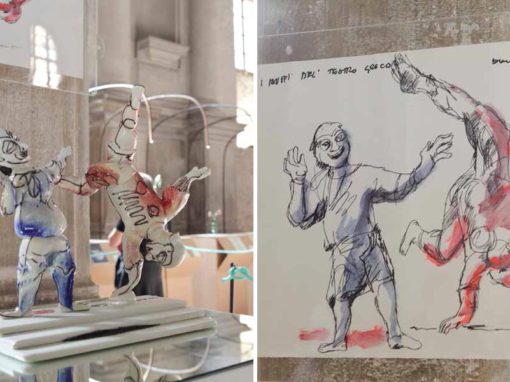
The School is available for any further information for individual and group courses regarding any glass technique or correlated to the world of glass, such as decorations, design, drawing, photography etc. Estimates upon request.
HOUSING
Anybody asking about lodging, the School will give help in searching in Murano for the following accommodation: Room in apartment to share with other students of the course B&B Mini apartments For information about type and prices contact: info@abatezanetti.it
Anybody asking about lodging Venice, the School will offer, in collaboration with Istituto Venezia*, the following accommodation: Room in apartment to share with other students of the course Room in a family Miniapartments (*a charge in addition of € 30 per person is to be paid) Prices are shown on the site www.istitutovenezia.com Contact santini@istitutovenezia.com
30 days notice are requested to find lodging both in Murano and Venice. (Accomodations go from the previous Sunday before the beginning of the course to the Saturday following the end of the course)
Application Form
First name Last name. Address Ph/mob/fax/email Course Other Level of knowledge Period Accommodation requested Deposit payed within/through I declare I have read and I accept the general conditions.
GENERAL CONDITONS
Cancellation of enrolment must be communicated by registered letter, fax or email. If cancellation take place at least thirty-days before the beginning of the course, only 20% of the deposit will be lost: the rest will be refunded. If cancellation takes places after this deadline, the entire deposit is forfeit. Lessons are held from Monday to Friday, excepting Italian public holidays: 6th january, april 5th, june 2nd, november 1st. If the student does not finish the course, fees will not be refunded. Any lessons unattended or any services unused will not be refunded. The school reserves the right to cancel courses should the minimum number of students not be reached. Any deposit already paid by the student in this case will be refunded. The school reserves the right to make such timetable changes as it seems necessary in the running of the Institute. All payments for accommodation must be made directly to the school. The school accepts no responsibility for personal possessions or objects brought onto the premises, or for any damage caused by its students. Students are insured through the school (though only when physically inside the building) by Assitalia policy n.3395 which covers accident, hospitalization and medical expenses. All students are, however, advised to bring with them proof of medical insurance coverage arranged in their own country.
DEMONSTRATION OFFERS FOR GROUPS (glassblowing, fusing, lampworking)
PART TIME DEMOSTRATION
TOTAL HOUR 3
MINIMUM NUMBER 10
PRIZE 60 euro per person
SCHEDULE
9.30-10.00: Introduction to History of Glass in Murano (lecture)
10.00-10.15: coffee break
10.15-10.55: explanation and demonstration of glassblowing and
solid working in Hotshop
10.55-11.35: explanation and demonstration of lampworking main techniques in Warmshop
11.35-12.50: break with coktail
12.50-13.30: explanation and demonstration of fusing in Fusing workshop
The prize includes
-lecture
-practical demonstrations
-coffee break and coktail break
-Handout with glass-vocabulary italian-english
-an assistant-interpreter if the “maestro” is a not speakingenglish
FULL TIME DEMONSTRATION
HOURS 5+1 hour of lunch break
MINIMUM NUMBER 10
PRIZE 90 euro per person
SCHEDULE
10.00-10.40: Introduction to History of Glass in Murano (lecture)
10.40-12.40: Visit guided to the Glass Museum in Murano
12.40-13.40: Lunch break (Optional: 25 euro p.p)
13.40-14.20: Explanation and demonstration of glassblowing and
solid working in Hotshop
14.20-15.00: Explanation and demonstration of lampworking main techniques in Warmshop
15.00-15.20: coffee break
15.20-16.00: explanation and demonstration of vetro-fusion technique in Fusing Worshop
The prize includes
-lecture
-practical demonstrations
-coffee break
-Glass Museum ticket
-Handout with glass-vocabulary italian-english
-an assistant-interpreter if the “maestro” is a not speakingenglish
Il sito è in costruzione e sarà modificato nei prossimi giorni. La Scuola è a disposizione per ogni richiesta per corsi individuali o per gruppi per qualsiasi tecnica vetraria o correlata al mondo del vetro, quali corsi di decorazione, di design, di disegno, di fotografia etc. Contattateci, saremo lieti di rispondere ad ogni domanda!